China Top 10 Ratchet Strap Types for Global Buyers

Time:2026-10-27 Author:Mason
0%

China’s ratchet strap industry serves global buyers with broad product choices, practical customization, and competitive manufacturing capacity. This guide introduces the China Top 10 Ratchet Strap Types for Global Buyers, covering common designs for logistics, trucking, warehousing, outdoor transport, and industrial cargo control.

“Cargo safety begins where the strap meets the load,” says Michael E. Hargis, a cargo-control specialist with long experience in tie-down systems. His observation is simple. Yet it is often overlooked.

A strong Ratchet Straps selection requires more than comparing prices. Buyers should examine webbing width, breaking strength, working load limit, hook shape, handle design, stitching quality, and corrosion resistance. A 25 mm strap may suit lighter cargo, while a 50 mm model often supports demanding transport applications. Different hooks also matter. Wire hooks, flat hooks, and J-hooks behave differently around pallets, rails, and vehicle anchor points.

This ranking considers product structure, material consistency, factory experience, testing practices, customization options, and export readiness. It also recognizes an uncomfortable point: no single strap type fits every market. A bright label does not prove dependable performance.

Look closely.

Reliable suppliers should provide clear specifications, traceable production information, and practical usage guidance. Buyers should also confirm whether stated capacities refer to breaking strength or working load limit. Confusing these figures can create serious purchasing errors.

The selected Chinese manufacturers and product categories may change as technology, buyer expectations, and transport conditions evolve. That limitation deserves attention. A thoughtful buyer should verify samples, inspection records, packaging details, and application requirements before placing a large order.
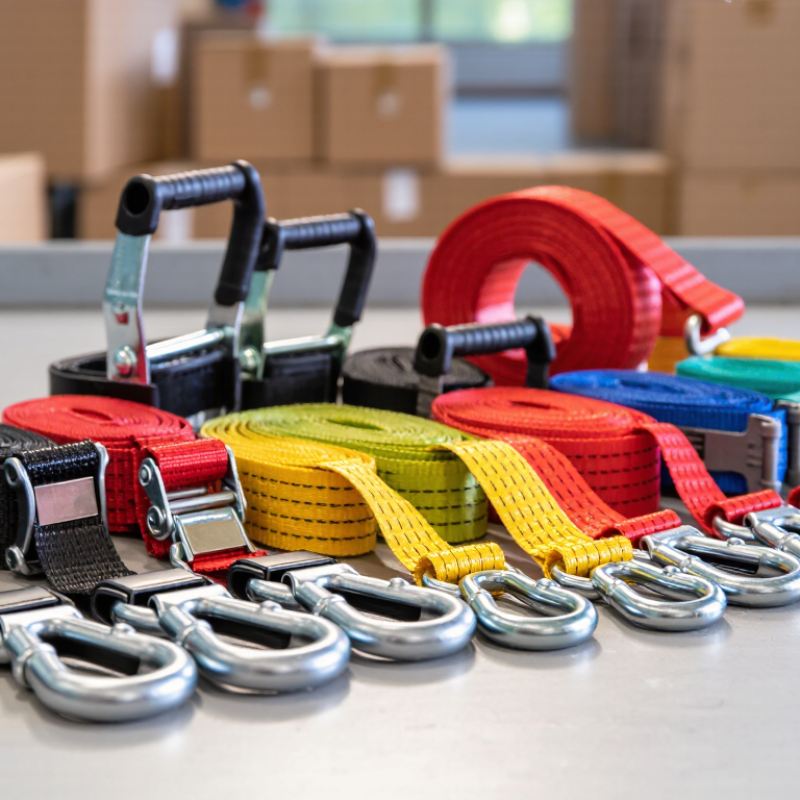
China Top 10 Ratchet Strap Types for Global Buyers

Ratchet Strap Basics and Their Role in Global Cargo Securement

Ratchet straps are webbing assemblies designed to hold cargo firmly during transport. A standard set includes polyester webbing, a tensioning handle, and end fittings. The ratchet winds the webbing around its spindle, creating controlled tension. Hooks or loops connect the strap to approved anchor points. This simple mechanism supports many cargo tasks, from pallets and machinery to outdoor equipment.

For global buyers, strap selection should begin with working load limit, not appearance. Webbing width, stitching quality, fitting shape, and break strength affect real performance. A 50-millimeter strap may suit heavier loads, while narrower webbing can work for lighter applications. The working load limit must match the cargo weight and the available anchor points. Labels should remain clear and permanent. Missing information creates avoidable uncertainty. Buyers should also check local transport requirements before placing large orders.

Practical loading details matter. Sharp steel edges can cut webbing, so edge protectors are often necessary. The strap should sit flat, without twists or trapped dirt. After tensioning, the handle must close and lock correctly. Vibration can loosen poorly positioned equipment. Rain, sunlight, oil, and repeated abrasion gradually weaken textile fibers. Inspectors should look for fraying, melted areas, damaged stitching, bent hooks, and unreadable labels. A common mistake is trusting a strap because it looks clean. That judgment is imperfect. Record inspections and remove doubtful straps from service.񎟀

China’s Top 10 Ratchet Strap Types by Design and Application

China’s top ten ratchet strap types reflect different designs and working environments. Standard flat-webbing straps suit pallets and light machinery. Heavy-duty straps use wider webbing and reinforced stitching for industrial loads. Endless-loop straps wrap around pipes, frames, and bundled materials. Soft-loop straps protect painted surfaces from metal hooks. Axle straps secure vehicles without touching fragile body panels. Motorcycle straps add handlebar-friendly loops and compact hooks. Retractable straps reduce loose webbing in vans and trailers. E-track straps connect with track fittings for organized cargo bays. Lashing straps with chain-end fittings support heavier transport equipment. Ratchet cargo nets combine multiple straps for irregular loads.

Design choices should follow measured load weight, contact points, and abrasion risk.

The U.S. Federal Motor Carrier Safety Administration requires cargo securement systems to provide a working load limit of at least half the cargo weight under 49 CFR 393.102.

That figure is often misunderstood. It is not a safe shortcut.

EN 12195-2 also requires clear markings for lashing capacity, standard hand force, and standard tension force.

The 2024 WSTDA tie-down guidance stresses inspection for cuts, heat damage, distorted hooks, and unreadable labels.

Market data adds commercial context: Grand View Research reported continued growth in global cargo-securing equipment demand, driven by logistics, construction, and vehicle transport. Still, market growth does not prove product quality.

A 2023 industry survey by a global testing association found webbing abrasion and incorrect tensioning among frequent field problems. The survey’s limitations deserve attention. Factory testing cannot fully reproduce wet roads, sharp edges, or rushed loading crews.

Key Materials, Load Ratings, Sizes, and Hardware Differences

China Top 10 Ratchet Strap Types for Global Buyers

Ratchet straps differ by webbing, rating, length, and hardware. Polyester is the common professional choice because it stretches less than nylon and resists moisture. Polypropylene is lighter and cheaper, but it usually offers lower strength and poorer abrasion resistance. For demanding cargo, inspect the webbing width, stitching pattern, edge protection, and working load limit, not only breaking strength.

Ratings need careful comparison. EN 12195-2 uses lashing capacity, standard hand force, and standard tension force. WSTDA guidance also separates breaking strength from working load limit. In the United States, FMCSA rules require the aggregate working load limit to reach at least half the cargo weight. The FMCSA Large Truck Crash Causation Study identified cargo shifting as a factor in about 7.5% of large-truck crashes. Small errors matter.

Sizes range from compact 25 mm straps to heavy-duty 75 mm assemblies. Common lengths run from 3 to 12 meters, though custom lengths reduce loose webbing. Flat hooks suit rails and anchor points; wire hooks fit narrow loops; chain-end designs handle sharper contact areas. S-hooks are convenient, but they may disengage under poor alignment. That is often overlooked. Buyers should request batch test records, label photos, corrosion checks, and stitching samples. A high rating means little when the anchor geometry is wrong.

How Global Buyers Should Match Strap Types to Transport Needs

China Top 10 Ratchet Strap Types for Global Buyers

How Global Buyers Should Match Strap Types to Transport Needs

Choosing ratchet straps should begin with the cargo, not the catalog. Flat-hook straps suit pallets and flatbed loads with secure anchor rails. Wire-hook straps fit narrow vehicle tie-down points. Endless-loop straps work well around machinery, pipes, and compact bundles. Cam-buckle straps are gentler for lightweight cartons, though they usually provide less tension.

For motorcycles or wheeled equipment, use axle straps with protective sleeves. Heavy machinery needs wider webbing, higher working load limits, and abrasion-resistant edge protection. Wet or coastal routes demand weather-resistant materials. Always compare the working load limit with cargo weight, restraint angles, and anchor strength.

The U.S. FMCSA Cargo Securement Handbook states that aggregate tiedown working load limits should reach at least half the cargo weight. European buyers commonly reference EN 12195-2 for lashing performance and labeling. The 2023 CVSA International Roadcheck inspected 59,429 commercial vehicles, with 19.3% receiving out-of-service orders. Cargo securement remained a recurring inspection concern.

Do not trust tension by feel.

A strap can look strong and still fail at a damaged edge. Inspect stitching, hooks, labels, and ratchet teeth before loading. Buyers should also request test records and batch traceability from suppliers. I have seen specifications focus on breaking strength while ignoring anchor compatibility. That is a costly blind spot. A more careful choice may be slower, but it prevents unstable loads and avoidable replacement costs.

Quality Standards, Customization Options, and Supplier Evaluation Criteria

China Top 10 Ratchet Strap Types for Global Buyers

Quality starts with traceable testing, not attractive packaging. EN 12195-2 requires clear markings for lashing capacity, standard hand force, and standard tension force. In the United States, FMCSA rules require a tiedown system’s aggregate working load limit to reach at least half the cargo weight. NHTSA’s Traffic Safety Facts 2022 recorded 5,837 large trucks involved in fatal crashes. This figure does not isolate strap failures, but it shows why cargo control deserves careful supplier review. A serious factory should provide batch records, webbing test results, hook strength data, and corrosion checks. Ask for the original reports.

Specifications should match the route and load. Polyester webbing suits many general cargo applications, while edge protection helps prevent sharp corners from cutting fibers. Custom options may include strap length, width, hook design, handle shape, labels, and packaging. Yet customization can hide weak engineering. That mistake still happens. Request samples before approving volume production. Check stitching density, ratchet movement, release force, and label accuracy by hand. WSTDA-T-1 testing guidance is useful for evaluating webbing assemblies and hardware, but buyers should confirm which tests were actually completed. A supplier with ISO 9001 certification may control processes better, but certification alone proves little about strap performance. Review corrective-action records, inspection frequency, material traceability, and independent laboratory results. A clean sample is not enough. Supplier honesty matters.

FAQS

Which ratchet strap type suits pallets and light machinery?

Standard flat-webbing straps work well with pallets and flatbed cargo. Use secure anchor rails and check the load weight first. Simple choice, sometimes.

When should I use endless-loop or soft-loop straps?

Endless-loop straps wrap around pipes, frames, and bundled materials. Soft-loop straps protect painted surfaces from metal hooks. Inspect contact points for sharp edges.

Which straps are suitable for motorcycles and wheeled equipment?

Axle straps secure vehicles without pressing against fragile body panels. Motorcycle straps may include handlebar-friendly loops and compact hooks. Add protective sleeves.

What are retractable, E-track, and chain-end straps used for?

Retractable straps reduce loose webbing inside vans and trailers. E-track straps organize cargo bays with compatible track fittings. Chain-end fittings support heavier transport equipment.

How should I choose a strap for irregular loads?

Ratchet cargo nets combine several straps around uneven cargo. They can cover gaps better than one strap. Check every corner and contact point.

How much working load limit should the tiedowns provide?

U.S. cargo rules generally require aggregate working load limits of at least half the cargo weight. This is a minimum, not permission to relax. Anchor strength and restraint angles also matter.

What should buyers inspect before loading?

Check cuts, heat damage, worn stitching, distorted hooks, ratchet teeth, and unreadable labels. Do not trust tension by feel. A strong-looking strap may hide damaged fibers.

What should I request from a supplier?

Request test records, batch traceability, webbing results, hook data, and corrosion checks. Ask for samples before volume production. A clean sample proves little.

Does customization guarantee better performance?

No. Custom length, width, hooks, handles, labels, and packaging may improve fit. Weak engineering can still remain underneath. I would verify each change again.

Are factory tests enough for real transport conditions?

Not always. Wet roads, sharp edges, coastal air, and rushed loading can change performance. Laboratory results help, but field risks need separate attention.

Conclusion

This guide introduces Ratchet Straps as essential cargo-securing tools for transportation, warehousing, and international logistics. It explains how their tensioning mechanisms, webbing construction, hooks, and end fittings work together to stabilize loads and reduce movement during transit. The article also reviews China’s top ten ratchet strap types by design and application, including standard tie-downs, heavy-duty models, endless loop styles, cam buckle alternatives, and specialized configurations for different cargo shapes and transport conditions.

Global buyers will learn how to compare materials such as polyester webbing, select suitable working load limits, and evaluate differences in strap width, length, stitching, ratchet strength, and hardware coatings. Practical guidance is provided for matching each strap type to trucks, trailers, containers, warehouses, and other transport needs. The guide also highlights quality control, testing documentation, customization options, packaging, production consistency, and supplier evaluation criteria, helping buyers select reliable products that meet operational requirements and applicable safety expectations.


Mason

Mason

Mason is a seasoned marketing professional with a deep expertise in the company's offerings and a passion for driving brand awareness. With a strong background in digital marketing strategies, he has an innate ability to connect with diverse audiences and effectively communicate product benefits.......